
并行连接的网络 (GoogLeNet)
探索GoogLeNet的Inception架构创新,学习多尺度并行卷积的设计理念
展开文章目录
GoogLeNet的设计灵感
双重设计理念
- “We Need To Go Deeper” - 通过更深的网络结构提高性能,借鉴 NiN 网络设计
- “全面启动” - 同时引入多种卷积核尺寸的并行组合 (1×1, 3×3, 5×5)
- “梦中梦” - 逐层深入的多层次特征捕捉概念
受《盗梦空间 (Inception)》影响
一方面,电影《盗梦空间 (Inception)》的台词”We Need To Go Deeper”被 GoogLeNet 用于强调模型通过更深的网络结构,进一步提高性能的方式。在具体实现上,借鉴了 NiN 网络。
另一方面,电影台湾译名”全面启动”似乎更能说明 GoogLeNet 同时引入多种卷积核尺寸的并行组合(1×1、3×3 和 5×5),捕捉多层次特征。这与电影中”梦中梦”逐层深入的概念不谋而合。
/1735528068141-f82ddf13-ae49-434e-a512-a79ff74695a0.jpeg)
1. GoogLeNet 网络架构设计
1.1 Inception 块的核心思想
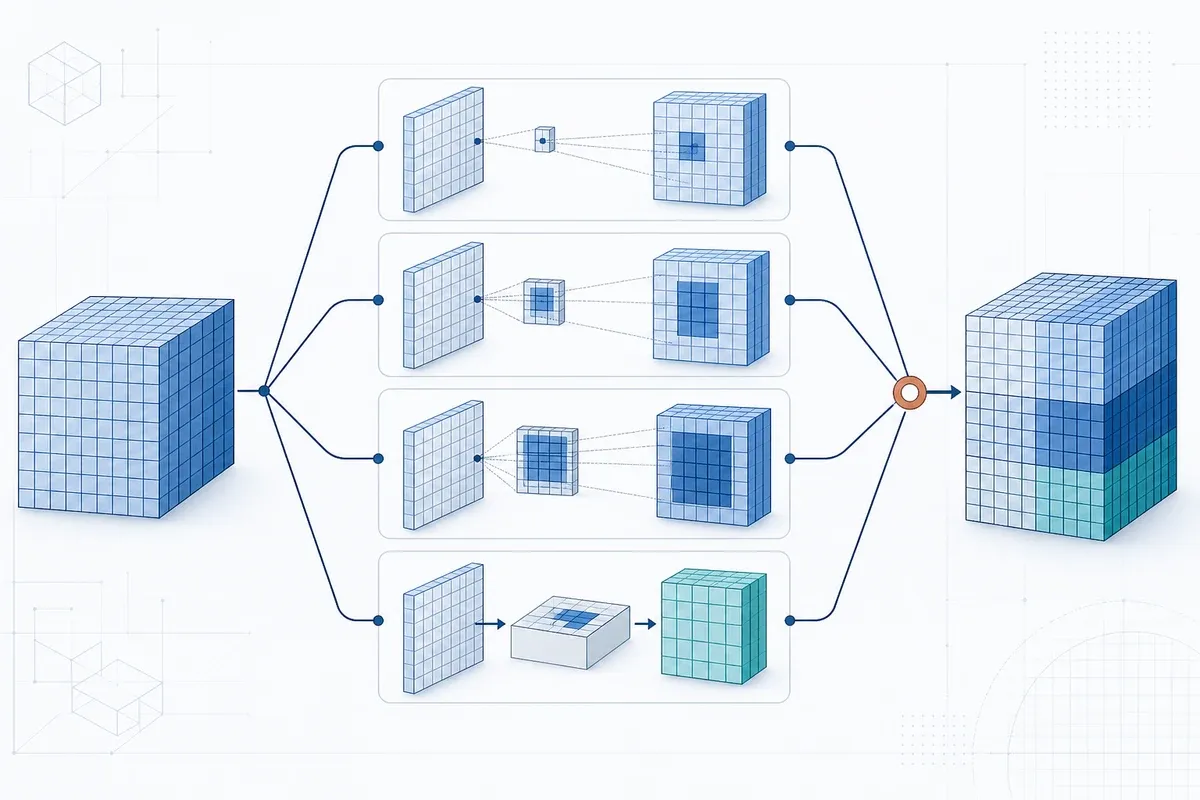
1.2 四种并行路径设计
Inception并行路径
1×1 卷积层
- 提取通道特征并降维
- 计算效率最高的路径
1×1 卷积层 → 3×3 卷积层
- 先对通道降维,减少计算量
- 随后提取较大的空间特征
1×1 卷积层 → 5×5 卷积层
- 先对通道降维,减少计算量
- 随后提取更大的空间特征
3×3 最大池化层 → 1×1 卷积层
- 先下采样特征图,保留重要信息
- 随后调整通道数,匹配其他路径
/1735530604076-85cb3a15-2e94-4811-8585-1c760cdb6f33.png)
1.3 Inception 块的 PyTorch 实现
Inception 块IncepBlock的 PyTorch 实现如下:
from typing import Tuple

import torch
from torch import nn


class IncepBlock(nn.Module):
    def __init__(self, in_channels: int, c1_out: int, c2_out: Tuple[int, int], c3_out: Tuple[int, int], c4_out: int):
        super().__init__()

        self.channel1 = nn.Sequential(  # 路径一: 1×1 卷积
            nn.Conv2d(in_channels, c1_out, kernel_size=1), nn.ReLU()
        )

        self.channel2 = nn.Sequential(  # 路径二: 1×1 卷积 -> 3×3 卷积
            nn.Conv2d(in_channels, c2_out[0], kernel_size=1), nn.ReLU(),
            nn.Conv2d(c2_out[0], c2_out[1], kernel_size=3, padding=1), nn.ReLU()
        )

        self.channel3 = nn.Sequential(  # 路径三: 1×1 卷积 -> 5×5 卷积
            nn.Conv2d(in_channels, c3_out[0], kernel_size=1), nn.ReLU(),
            nn.Conv2d(c3_out[0], c3_out[1], kernel_size=5, padding=2), nn.ReLU()
        )

        self.channel4 = nn.Sequential(  # 路径四: 3×3 最大池化 -> 1×1 卷积
            nn.MaxPool2d(kernel_size=3, stride=1, padding=1),
            nn.Conv2d(in_channels, c4_out, kernel_size=1), nn.ReLU()
        )

    def forward(self, x):
        output1 = self.channel1(x)
        output2 = self.channel2(x)
        output3 = self.channel3(x)
        output4 = self.channel4(x)
        output = torch.cat([output1, output2, output3, output4], dim=1)
        return output
2. GoogLeNet 完整网络架构
2.1 网络整体设计
2.2 适配 Fashion-MNIST 的设计
/1735548212468-4e56efe8-a8c8-44f4-9406-aced2945ad9b.png)
from typing import Tuple

import torch
from torch import nn, Tensor


class IncepBlock(nn.Module):
    def __init__(self, in_channels: int, c1_out: int, c2_out: Tuple[int, int], c3_out: Tuple[int, int], c4_out: int):
        super().__init__()

        self.channel1 = nn.Sequential(  # 路径一: 1×1 卷积
            nn.Conv2d(in_channels, c1_out, kernel_size=1), nn.ReLU()
        )

        self.channel2 = nn.Sequential(  # 路径二: 1×1 卷积 -> 3×3 卷积
            nn.Conv2d(in_channels, c2_out[0], kernel_size=1), nn.ReLU(),
            nn.Conv2d(c2_out[0], c2_out[1], kernel_size=3, padding=1), nn.ReLU()
        )

        self.channel3 = nn.Sequential(  # 路径三: 1×1 卷积 -> 5×5 卷积
            nn.Conv2d(in_channels, c3_out[0], kernel_size=1), nn.ReLU(),
            nn.Conv2d(c3_out[0], c3_out[1], kernel_size=5, padding=2), nn.ReLU()
        )

        self.channel4 = nn.Sequential(  # 路径四: 3×3 最大汇聚 -> 1×1 卷积
            nn.MaxPool2d(kernel_size=3, stride=1, padding=1),
            nn.Conv2d(in_channels, c4_out, kernel_size=1), nn.ReLU()
        )

    def forward(self, x) -> Tensor:
        output1 = self.channel1(x)
        output2 = self.channel2(x)
        output3 = self.channel3(x)
        output4 = self.channel4(x)
        output = torch.cat([output1, output2, output3, output4], dim=1)
        return output


class GoogLeNet(nn.Module):
    def __init__(self, num_classes: int):
        super().__init__()
        self.model = nn.Sequential(
            nn.Conv2d(in_channels=1, out_channels=64, kernel_size=7, stride=2, padding=3), nn.ReLU(),
            nn.MaxPool2d(kernel_size=3, stride=2, padding=1),

            nn.Conv2d(in_channels=64, out_channels=64, kernel_size=1), nn.ReLU(),
            nn.Conv2d(in_channels=64, out_channels=192, kernel_size=3, padding=1), nn.ReLU(),
            nn.MaxPool2d(kernel_size=3, stride=2, padding=1),

            IncepBlock(in_channels=192, c1_out=64, c2_out=(96, 128), c3_out=(16, 32), c4_out=32),
            IncepBlock(in_channels=256, c1_out=128, c2_out=(128, 192), c3_out=(32, 96), c4_out=64),
            nn.MaxPool2d(kernel_size=3, stride=2, padding=1),

            IncepBlock(in_channels=480, c1_out=192, c2_out=(96, 208), c3_out=(16, 48), c4_out=64),
            IncepBlock(in_channels=512, c1_out=160, c2_out=(112, 224), c3_out=(24, 64), c4_out=64),
            IncepBlock(in_channels=512, c1_out=128, c2_out=(128, 256), c3_out=(24, 64), c4_out=64),
            IncepBlock(in_channels=512, c1_out=112, c2_out=(144, 288), c3_out=(32, 64), c4_out=64),
            IncepBlock(in_channels=528, c1_out=256, c2_out=(160, 320), c3_out=(32, 128), c4_out=128),
            nn.MaxPool2d(kernel_size=3, stride=2, padding=1),

            IncepBlock(in_channels=832, c1_out=256, c2_out=(160, 320), c3_out=(32, 128), c4_out=128),
            IncepBlock(in_channels=832, c1_out=384, c2_out=(192, 384), c3_out=(48, 128), c4_out=128),
            nn.AdaptiveAvgPool2d(1), nn.Flatten(),
            nn.Linear(in_features=1024, out_features=num_classes)
        )

        self._initialize_weights()

    def _initialize_weights(self):
        for m in self.modules():
            if isinstance(m, nn.Conv2d):
                nn.init.kaiming_normal_(m.weight, mode='fan_in', nonlinearity='relu')
                if m.bias is not None: nn.init.constant_(m.bias, 0)
            elif isinstance(m, nn.Linear):
                nn.init.xavier_uniform_(m.weight)
                if m.bias is not None: nn.init.constant_(m.bias, 0)

    def forward(self, x) -> Tensor:
        return self.model(x)
2.3 网络结构分析
使用torchinfo库的summary函数执行输出维度测试:
from torchinfo import summary

model = GoogLeNet(num_classes=10)
summary(model, input_size=(1, 1, 96, 96))
==========================================================================================
Layer (type:depth-idx)                   Output Shape              Param #
==========================================================================================
GoogLeNet                                [1, 10]                   --
├─Sequential: 1-1                        [1, 10]                   --
│    └─Conv2d: 2-1                       [1, 64, 48, 48]           3,200
│    └─ReLU: 2-2                         [1, 64, 48, 48]           --
│    └─MaxPool2d: 2-3                    [1, 64, 24, 24]           --
│    └─Conv2d: 2-4                       [1, 64, 24, 24]           4,160
│    └─ReLU: 2-5                         [1, 64, 24, 24]           --
│    └─Conv2d: 2-6                       [1, 192, 24, 24]          110,784
│    └─ReLU: 2-7                         [1, 192, 24, 24]          --
│    └─MaxPool2d: 2-8                    [1, 192, 12, 12]          --
│    └─IncepBlock: 2-9                   [1, 256, 12, 12]          --
│    │    └─Sequential: 3-1              [1, 64, 12, 12]           12,352
│    │    └─Sequential: 3-2              [1, 128, 12, 12]          129,248
│    │    └─Sequential: 3-3              [1, 32, 12, 12]           15,920
│    │    └─Sequential: 3-4              [1, 32, 12, 12]           6,176
│    └─IncepBlock: 2-10                  [1, 480, 12, 12]          --
│    │    └─Sequential: 3-5              [1, 128, 12, 12]          32,896
│    │    └─Sequential: 3-6              [1, 192, 12, 12]          254,272
│    │    └─Sequential: 3-7              [1, 96, 12, 12]           85,120
│    │    └─Sequential: 3-8              [1, 64, 12, 12]           16,448
│    └─MaxPool2d: 2-11                   [1, 480, 6, 6]            --
│    └─IncepBlock: 2-12                  [1, 512, 6, 6]            --
│    │    └─Sequential: 3-9              [1, 192, 6, 6]            92,352
│    │    └─Sequential: 3-10             [1, 208, 6, 6]            226,096
│    │    └─Sequential: 3-11             [1, 48, 6, 6]             26,944
│    │    └─Sequential: 3-12             [1, 64, 6, 6]             30,784
│    └─IncepBlock: 2-13                  [1, 512, 6, 6]            --
│    │    └─Sequential: 3-13             [1, 160, 6, 6]            82,080
│    │    └─Sequential: 3-14             [1, 224, 6, 6]            283,472
│    │    └─Sequential: 3-15             [1, 64, 6, 6]             50,776
│    │    └─Sequential: 3-16             [1, 64, 6, 6]             32,832
│    └─IncepBlock: 2-14                  [1, 512, 6, 6]            --
│    │    └─Sequential: 3-17             [1, 128, 6, 6]            65,664
│    │    └─Sequential: 3-18             [1, 256, 6, 6]            360,832
│    │    └─Sequential: 3-19             [1, 64, 6, 6]             50,776
│    │    └─Sequential: 3-20             [1, 64, 6, 6]             32,832
│    └─IncepBlock: 2-15                  [1, 528, 6, 6]            --
│    │    └─Sequential: 3-21             [1, 112, 6, 6]            57,456
│    │    └─Sequential: 3-22             [1, 288, 6, 6]            447,408
│    │    └─Sequential: 3-23             [1, 64, 6, 6]             67,680
│    │    └─Sequential: 3-24             [1, 64, 6, 6]             32,832
│    └─IncepBlock: 2-16                  [1, 832, 6, 6]            --
│    │    └─Sequential: 3-25             [1, 256, 6, 6]            135,424
│    │    └─Sequential: 3-26             [1, 320, 6, 6]            545,760
│    │    └─Sequential: 3-27             [1, 128, 6, 6]            119,456
│    │    └─Sequential: 3-28             [1, 128, 6, 6]            67,712
│    └─MaxPool2d: 2-17                   [1, 832, 3, 3]            --
│    └─IncepBlock: 2-18                  [1, 832, 3, 3]            --
│    │    └─Sequential: 3-29             [1, 256, 3, 3]            213,248
│    │    └─Sequential: 3-30             [1, 320, 3, 3]            594,400
│    │    └─Sequential: 3-31             [1, 128, 3, 3]            129,184
│    │    └─Sequential: 3-32             [1, 128, 3, 3]            106,624
│    └─IncepBlock: 2-19                  [1, 1024, 3, 3]           --
│    │    └─Sequential: 3-33             [1, 384, 3, 3]            319,872
│    │    └─Sequential: 3-34             [1, 384, 3, 3]            823,872
│    │    └─Sequential: 3-35             [1, 128, 3, 3]            193,712
│    │    └─Sequential: 3-36             [1, 128, 3, 3]            106,624
│    └─AdaptiveAvgPool2d: 2-20           [1, 1024, 1, 1]           --
│    └─Flatten: 2-21                     [1, 1024]                 --
│    └─Linear: 2-22                      [1, 10]                   10,250
==========================================================================================
Total params: 5,977,530
Trainable params: 5,977,530
Non-trainable params: 0
Total mult-adds (Units.MEGABYTES): 276.66
==========================================================================================
Input size (MB): 0.04
Forward/backward pass size (MB): 4.74
Params size (MB): 23.91
Estimated Total Size (MB): 28.69
==========================================================================================3. 模型训练与评估
3.1 训练配置与实现
继续使用training_tools.py中的工具训练评估模型:
from typing import Tuple

import torch
from torch import nn, Tensor, optim

from training_tools import fashionMNIST_loader, Trainer


class IncepBlock(nn.Module):
    def __init__(self, in_channels: int, c1_out: int, c2_out: Tuple[int, int], c3_out: Tuple[int, int], c4_out: int):
        super().__init__()

        self.channel1 = nn.Sequential(  # 路径一: 1×1 卷积
            nn.Conv2d(in_channels, c1_out, kernel_size=1), nn.ReLU()
        )

        self.channel2 = nn.Sequential(  # 路径二: 1×1 卷积 -> 3×3 卷积
            nn.Conv2d(in_channels, c2_out[0], kernel_size=1), nn.ReLU(),
            nn.Conv2d(c2_out[0], c2_out[1], kernel_size=3, padding=1), nn.ReLU()
        )

        self.channel3 = nn.Sequential(  # 路径三: 1×1 卷积 -> 5×5 卷积
            nn.Conv2d(in_channels, c3_out[0], kernel_size=1), nn.ReLU(),
            nn.Conv2d(c3_out[0], c3_out[1], kernel_size=5, padding=2), nn.ReLU()
        )

        self.channel4 = nn.Sequential(  # 路径四: 3×3 最大汇聚 -> 1×1 卷积
            nn.MaxPool2d(kernel_size=3, stride=1, padding=1),
            nn.Conv2d(in_channels, c4_out, kernel_size=1), nn.ReLU()
        )

    def forward(self, x) -> Tensor:
        output1 = self.channel1(x)
        output2 = self.channel2(x)
        output3 = self.channel3(x)
        output4 = self.channel4(x)
        output = torch.cat([output1, output2, output3, output4], dim=1)
        return output


class GoogLeNet(nn.Module):
    def __init__(self, num_classes: int):
        super().__init__()
        self.model = nn.Sequential(
            nn.Conv2d(in_channels=1, out_channels=64, kernel_size=7, stride=2, padding=3), nn.ReLU(),
            nn.MaxPool2d(kernel_size=3, stride=2, padding=1),

            nn.Conv2d(in_channels=64, out_channels=64, kernel_size=1), nn.ReLU(),
            nn.Conv2d(in_channels=64, out_channels=192, kernel_size=3, padding=1), nn.ReLU(),
            nn.MaxPool2d(kernel_size=3, stride=2, padding=1),

            IncepBlock(in_channels=192, c1_out=64, c2_out=(96, 128), c3_out=(16, 32), c4_out=32),
            IncepBlock(in_channels=256, c1_out=128, c2_out=(128, 192), c3_out=(32, 96), c4_out=64),
            nn.MaxPool2d(kernel_size=3, stride=2, padding=1),

            IncepBlock(in_channels=480, c1_out=192, c2_out=(96, 208), c3_out=(16, 48), c4_out=64),
            IncepBlock(in_channels=512, c1_out=160, c2_out=(112, 224), c3_out=(24, 64), c4_out=64),
            IncepBlock(in_channels=512, c1_out=128, c2_out=(128, 256), c3_out=(24, 64), c4_out=64),
            IncepBlock(in_channels=512, c1_out=112, c2_out=(144, 288), c3_out=(32, 64), c4_out=64),
            IncepBlock(in_channels=528, c1_out=256, c2_out=(160, 320), c3_out=(32, 128), c4_out=128),
            nn.MaxPool2d(kernel_size=3, stride=2, padding=1),

            IncepBlock(in_channels=832, c1_out=256, c2_out=(160, 320), c3_out=(32, 128), c4_out=128),
            IncepBlock(in_channels=832, c1_out=384, c2_out=(192, 384), c3_out=(48, 128), c4_out=128),
            nn.AdaptiveAvgPool2d(1), nn.Flatten(),
            nn.Linear(in_features=1024, out_features=num_classes)
        )

        self._initialize_weights()

    def _initialize_weights(self):
        for m in self.modules():
            if isinstance(m, nn.Conv2d):
                nn.init.kaiming_normal_(m.weight, mode='fan_in', nonlinearity='relu')
                if m.bias is not None: nn.init.constant_(m.bias, 0)
            elif isinstance(m, nn.Linear):
                nn.init.xavier_uniform_(m.weight)
                if m.bias is not None: nn.init.constant_(m.bias, 0)

    def forward(self, x) -> Tensor:
        return self.model(x)


if __name__ == '__main__':
    BATCH_SIZE = 128
    EPOCHS_NUM = 30
    LEARNING_RATE = 0.005

    model = GoogLeNet(num_classes=10)
    train_loader, test_loader = fashionMNIST_loader(BATCH_SIZE, resize=96)
    criterion = nn.CrossEntropyLoss()
    optimizer = optim.SGD(model.parameters(), LEARNING_RATE)
    platform = torch.device('cuda' if torch.cuda.is_available() else 'cpu')

    with Trainer(model, train_loader, test_loader, criterion, optimizer, platform) as trainer:
        trainer.train(EPOCHS_NUM)
3.2 训练结果与分析
查看完整训练过程
第 001/30 轮,训练损失:1.0233,训练精度:64.77%,测试损失:0.5896,测试精度:78.30%
第 002/30 轮,训练损失:0.5145,训练精度:81.14%,测试损失:0.4663,测试精度:83.26%
第 003/30 轮,训练损失:0.4330,训练精度:84.10%,测试损失:0.4222,测试精度:84.27%
第 004/30 轮,训练损失:0.3915,训练精度:85.55%,测试损失:0.3902,测试精度:85.33%
第 005/30 轮,训练损失:0.3597,训练精度:86.72%,测试损失:0.6181,测试精度:78.45%
第 006/30 轮,训练损失:0.3360,训练精度:87.59%,测试损失:0.4024,测试精度:85.58%
第 007/30 轮,训练损失:0.3194,训练精度:88.19%,测试损失:0.3629,测试精度:86.59%
第 008/30 轮,训练损失:0.3041,训练精度:88.78%,测试损失:0.3193,测试精度:88.33%
第 009/30 轮,训练损失:0.2902,训练精度:89.14%,测试损失:0.3558,测试精度:86.62%
第 010/30 轮,训练损失:0.2797,训练精度:89.57%,测试损失:0.3258,测试精度:88.02%
第 011/30 轮,训练损失:0.2684,训练精度:90.09%,测试损失:0.2906,测试精度:89.48%
第 012/30 轮,训练损失:0.2612,训练精度:90.34%,测试损失:0.3176,测试精度:88.67%
第 013/30 轮,训练损失:0.2493,训练精度:90.71%,测试损失:0.2911,测试精度:89.44%
第 014/30 轮,训练损失:0.2429,训练精度:90.96%,测试损失:0.3492,测试精度:87.41%
第 015/30 轮,训练损失:0.2351,训练精度:91.34%,测试损失:0.3176,测试精度:88.10%
第 016/30 轮,训练损失:0.2292,训练精度:91.44%,测试损失:0.2931,测试精度:88.95%
第 017/30 轮,训练损失:0.2221,训练精度:91.71%,测试损失:0.3761,测试精度:86.24%
第 018/30 轮,训练损失:0.2123,训练精度:92.17%,测试损失:0.2816,测试精度:89.70%
第 019/30 轮,训练损失:0.2087,训练精度:92.14%,测试损失:0.3294,测试精度:88.39%
第 020/30 轮,训练损失:0.2000,训练精度:92.52%,测试损失:0.2823,测试精度:89.97%
第 021/30 轮,训练损失:0.1973,训练精度:92.78%,测试损失:0.2764,测试精度:90.12%
第 022/30 轮,训练损失:0.1918,训练精度:92.79%,测试损失:0.2800,测试精度:89.67%
第 023/30 轮,训练损失:0.1846,训练精度:93.20%,测试损失:0.2640,测试精度:90.43%
第 024/30 轮,训练损失:0.1796,训练精度:93.38%,测试损失:0.2875,测试精度:89.47%
第 025/30 轮,训练损失:0.1744,训练精度:93.61%,测试损失:0.2566,测试精度:90.57%
第 026/30 轮,训练损失:0.1676,训练精度:93.80%,测试损失:0.2848,测试精度:89.85%
第 027/30 轮,训练损失:0.1627,训练精度:94.03%,测试损失:0.2633,测试精度:90.86%
第 028/30 轮,训练损失:0.1585,训练精度:94.17%,测试损失:0.2793,测试精度:90.02%
第 029/30 轮,训练损失:0.1545,训练精度:94.38%,测试损失:0.2631,测试精度:90.83%
第 030/30 轮,训练损失:0.1463,训练精度:94.52%,测试损失:0.2876,测试精度:90.21%/1735553846896-a7959802-7390-4fcc-becd-efe8acb34d7d.png)
DISCUSSION
讨论与回应
欢迎补充细节、指出问题,或分享与这篇文章有关的经验。